
BACK
Why ThinkBio.Ai® Leads the Next Generation of Biopharma AI Tools for Drug Discovery & Clinical Research (2026 Guide)
09/06/2026
3 months ago
Drug development remains one of the most complex challenges in modern science. Despite advances in genomics, molecular biology, and precision medicine, identifying the right target and translating it into a successful therapy remains a high-risk process.
Research teams generate vast amounts of biological and clinical data. The challenge is connecting that information into a clear understanding of disease mechanisms, therapeutic opportunities, and clinical outcomes.
This is where biopharma AI tools are creating measurable value. By combining artificial intelligence, multimodal data integration, and biological expertise, these platforms help researchers identify patterns, generate evidence-backed hypotheses, and make faster development decisions.
Among the growing number of AI drug discovery platforms, ThinkBio.Ai® has built a comprehensive ecosystem designed to support discovery, translational research, and clinical development through a unified approach to computable biology.
What Are Biopharma AI Tools?
Biopharma AI tools are specialized software platforms developed for pharmaceutical and biotechnology research. They are designed to analyze biological, molecular, clinical, and real-world data to support drug discovery and development workflows.
Unlike general-purpose AI systems, these platforms are trained and optimized for life sciences applications. Their purpose is to help researchers navigate biological complexity, prioritize opportunities, and reduce uncertainty throughout the R&D process.
Leading AI tools for drug discovery commonly support target identification, biomarker discovery, molecular screening, translational research, patient stratification, and clinical trial optimization.
Where AI Creates Value in Drug Discovery
• Target Identification
Selecting the right therapeutic target remains one of the most important decisions in drug development. AI helps researchers analyze genomic associations, pathway biology, multi-omics datasets, and scientific literature to identify disease-relevant targets.
By integrating multiple evidence sources, AI platforms can help prioritize targets with stronger biological rationale and greater translational potential.
• Translational Research
Many promising discoveries fail because biological findings do not translate effectively into clinical outcomes. AI enables researchers to connect molecular mechanisms, patient biology, and clinical evidence within a unified analytical framework.
This supports a deeper understanding of disease heterogeneity and helps guide therapeutic strategy.
• Drug Repurposing
Existing therapies often contain untapped potential across additional indications. AI-driven drug repurposing platforms analyze disease biology, molecular pathways, and published evidence to identify new opportunities for approved or investigational therapies.
This approach can significantly reduce development timelines compared with de novo drug discovery.
• Clinical Development
AI is increasingly being applied to patient identification, cohort design, and clinical trial planning. Advanced models can help researchers identify suitable patient populations and improve trial efficiency through data-driven decision support.
As precision medicine continues to evolve, AI is becoming an important component of modern clinical research strategies.
Why Many AI Drug Discovery Platforms Fall Short
Many AI solutions focus on a single stage of the drug development process. Some specialize in molecule generation, while others focus exclusively on target identification or literature mining.
Although these approaches can provide value, they often leave research teams working across disconnected systems and fragmented datasets.
The challenge is rarely a lack of algorithms. More often, it is the inability to connect biological knowledge, clinical evidence, and operational workflows into a unified decision-making environment.
Organizations increasingly require platforms that support the entire research journey rather than isolated analytical tasks.
The ThinkBio.Ai® Platform Ecosystem
ThinkBio.Ai® was designed to help research organizations transform fragmented biomedical information into actionable intelligence.
The platform combines biological expertise, knowledge graph technology, multimodal AI, and translational science to support decision-making across the R&D lifecycle.
Rather than functioning as a single application, ThinkBio.Ai® operates as an integrated ecosystem where data, models, and scientific insights continuously reinforce one another.
DrugSuccess.Ai™
DrugSuccess.Ai™ is ThinkBio.Ai®’s predictive intelligence platform for therapeutic evaluation and development strategy.
The platform integrates disease biology, target-associated genetics, multi-omics evidence, and scientific literature to generate explainable assessments that support drug development decision-making.
By combining knowledge graph intelligence with predictive analytics, DrugSuccess.Ai™ helps organizations evaluate therapeutic opportunities with greater confidence.
BioThinkHub®
BioThinkHub® serves as the data and intelligence foundation of the ThinkBio.Ai® ecosystem.
Built to support multi-modal biomedical data integration, the platform connects clinical data, multi-omics datasets, imaging information, scientific literature, and real-world evidence within a scalable analytical environment.
This enables researchers to work from a unified view of biology rather than isolated data silos.
TheraBluePrint®
TheraBluePrint® supports oncology-focused therapeutic development through AI-guided biomarker strategy and advanced biological analysis.
The platform incorporates emerging technologies such as spatial biology and transcriptomics to help researchers better understand tumor biology and patient heterogeneity.
These capabilities support more precise therapeutic design and patient selection strategies.
Additional ThinkBio.Ai® Solutions
The broader ThinkBio.Ai® ecosystem includes DrugReboot.Ai™ for drug repurposing, Pixelomics® for spatial biology and imaging analytics, TrialFit.Ai® for patient matching and clinical trial optimization, and expert AI agents including ThinkBio Sidney™ and ThinkBio EMIL™.
Together, these technologies create an interconnected environment designed to accelerate scientific discovery and improve development outcomes.
Other Notable AI Drug Discovery Tools in 2026
The AI drug discovery landscape includes a range of platforms focused on different stages of research and development. While some specialize in molecular design, others focus on target discovery, knowledge graph analysis, or virtual screening.
Schrödinger — Molecular Modeling & Lead Optimization
Schrödinger combines physics-based modeling with machine learning to support molecular design, lead optimization, and ADMET prediction. The platform is widely used in small-molecule drug discovery programs where structure-based design plays a central role.
Insilico Medicine — Generative Drug Discovery
Insilico Medicine applies generative AI to target discovery and molecule design. Its Chemistry42 platform uses machine learning to generate and optimize novel compounds, helping researchers accelerate early-stage discovery workflows.
BenevolentAI — Knowledge Graph-Driven Target Discovery
BenevolentAI leverages biomedical knowledge graphs and large-scale literature analysis to identify potential target-disease relationships. The platform is designed to help researchers uncover biological connections that may support target prioritization and hypothesis generation.
Atomwise — AI-Powered Virtual Screening
Atomwise applies deep learning to protein-ligand interactions for virtual screening and hit identification. Its AtomNet® platform helps researchers evaluate large compound libraries and prioritize candidates for further investigation.
Comparing Leading AI Drug Discovery Platforms
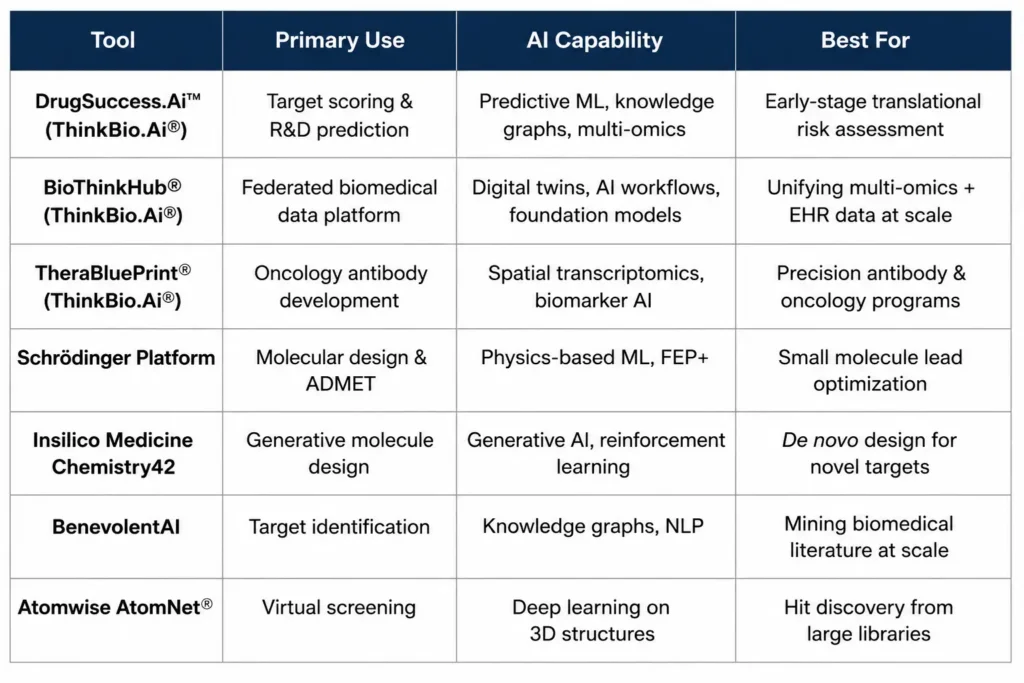
No single platform addresses every challenge in drug development.
Some organizations prioritize molecular design and compound optimization. Others focus on target discovery, translational research, or clinical intelligence.
ThinkBio.Ai® differentiates itself through its integrated ecosystem approach, combining discovery, translational science, data infrastructure, and clinical intelligence within a unified platform architecture.
This enables research teams to move beyond isolated predictions toward evidence-backed decision support across the entire development lifecycle.
What to Look for in a Biopharma AI Platform
• Biological Depth
Effective AI requires more than computational power. Platforms should demonstrate strong biological foundations and support meaningful interpretation of complex scientific data.
• Multi-Modal Data Integration
Drug discovery increasingly depends on combining genomics, proteomics, imaging, clinical information, and real-world evidence. Platforms that support these data types provide a more complete view of disease biology.
• Explainability
Research teams need to understand how predictions are generated. Explainable AI improves confidence, supports validation, and helps translate computational findings into actionable scientific decisions.
• Scalability
Data volumes continue to expand across research and clinical environments. Cloud-native platforms designed for large-scale biomedical data management are better positioned to support future growth.
• Security and Compliance
Biopharma organizations require robust governance frameworks when working with sensitive biological and clinical data. Compliance, security, and transparency remain essential platform requirements.
The Future of AI in Drug Discovery
The next generation of biopharma AI tools will move beyond prediction toward scientific reasoning.
Advances in multimodal AI, biological knowledge graphs, digital twins, and agentic systems are enabling more sophisticated approaches to research and development.
As these technologies mature, the focus will shift from generating insights to supporting complex scientific decisions across discovery, translational research, and clinical development.
Organizations that successfully combine biological expertise with AI-driven intelligence will be best positioned to navigate the growing complexity of modern drug development.
ThinkBio.Ai® was built around this principle. By combining multimodal AI, knowledge graph intelligence, translational science, and enterprise-grade infrastructure, the platform helps organizations accelerate discovery, reduce uncertainty, and make more informed development decisions.
As drug development becomes increasingly data-driven, platforms that make biology computable, explainable, and actionable will play an increasingly important role in bringing new therapies to patients.

Build the future of
biology with us
Contact Us
Stay Ahead with
ThinkBio.Ai®
Subscribe to our newsletter to receive the latest updates on products, sustainability efforts and services.