BACK
How ThinkBio.Ai® Uses Claude for Agricultural Field Trial Data Collection and Analysis
Agricultural field trials generate valuable decision making information for agricultural and related food businesses, from R&D investment to product positioning and branding. Capturing that information from the field accurately while the work is happening, however, can be difficult.
Researchers may be moving between plants, working around irrigation and water misting sometimes in hot conditions while handling phenotyping tools to make measurements. Typing every observation into a phone or tablet can interrupt the assessment itself. Later, that information also needs enough context to be useful: which trial did it belong to, which variety was assessed, what assessment was performed, and when and where was it recorded?
ThinkBio.Ai® worked with the largest fresh producer in North America to address this data journey through Field Trial Data Capture, a connected solution that combines voice-led data collection, offline operation, structured trial information, and conversational AI. The goal was to make information seamless to capture in the field while preserving the context needed to analyze it later.
Why is agricultural field trial data difficult to capture?
Agricultural trials produce both structured and unstructured information. A researcher may record a numerical assessment alongside a qualitative observation, photograph, video, or supporting document. These elements need to remain connected to provide useful context for later analysis.
The environment itself creates additional challenges. Researchers may need to handle measurement tools occupying with both hands, move between plants and plots, or collect information where connectivity is unreliable. A data-entry workflow designed for a desk does not necessarily translate well to a greenhouse.
A 2026 review in Methods in Ecology and Evolution describes field data collection as challenging and potentially error-prone and highlights the importance of appropriate data structures, identifiers, collection protocols, and technology.
Field Trial Data Capture was designed around these conditions, connecting field collection with the structured information required for later retrieval and analysis.
How does Field Trial Data Capture collect agricultural field data?
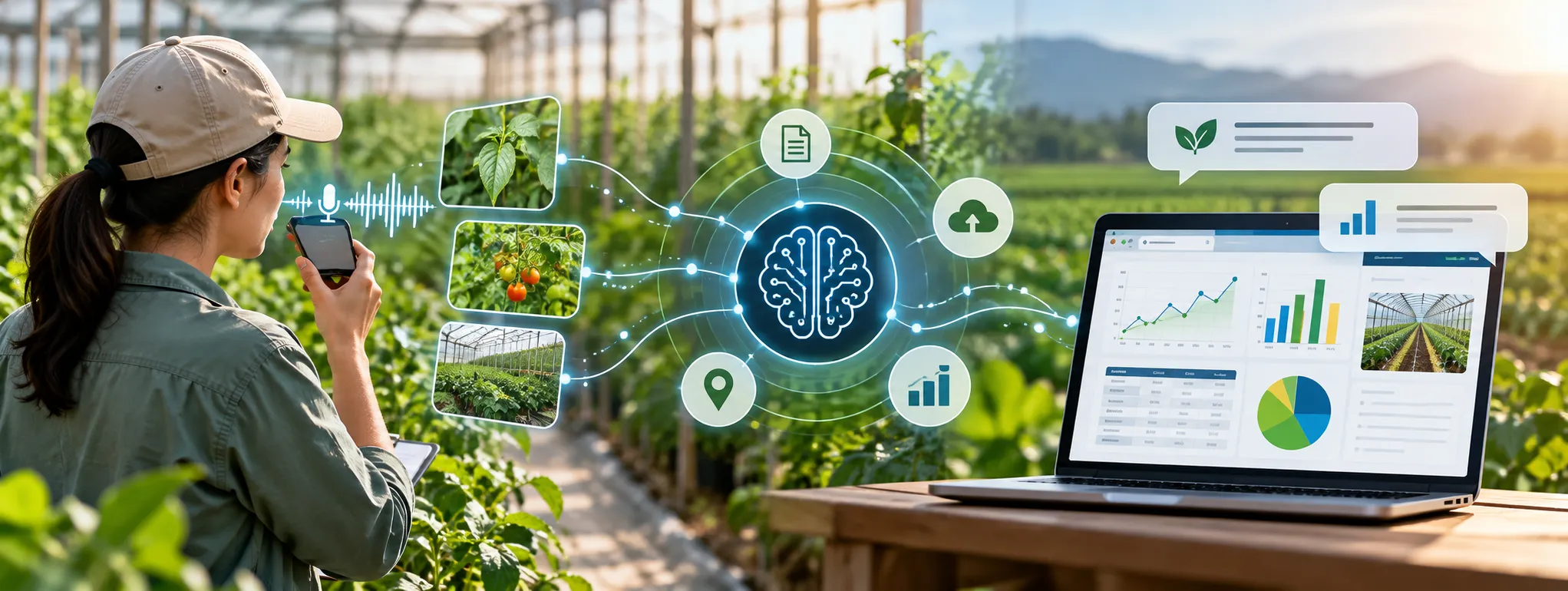
Field Trial Data Capture gives the users a mobile workflow for recording any assessments without requiring them to manually type the observation. They can speak naturally about the observation while continuing the assessment, and the system converts that input into structured information.
The voice workflow uses Whisper Large-v3 for speech-to-text and Claude Haiku 4.5 to interpret the resulting text and classify the information into the appropriate fields. This is important when a single spoken observation contains several pieces of information that need to be associated with the correct trial context, such as a variety, plot, assessment, or measurement.
The workflow also supports images and videos and can operate offline. Relevant trial information can be available on the device, allowing users to continue collecting data when connectivity is unavailable. Once connectivity returns, the captured information can synchronize with the connected backend.
Utilizing this workflow, voice-led capture reduces field data-collection time by approximately 75% compared with paper-based methods, while allowing a researcher to complete an assessment without requiring a second person to record the observation.
Why does structured agricultural data matter for AI?
The usefulness of conversational AI depends on the information it can reliably retrieve. Agricultural trial data can span trials, plots, varieties, greenhouses, assessments, media, and supporting documents. If these elements are captured inconsistently, additional work is required before they can be compared or analyzed.
Field Trial Data Capture addresses this at the point of collection by organizing trial information around the entities and relationships researchers need later. An observation therefore remains connected to the trial, variety, assessment, and other relevant information instead of becoming an isolated note.
This structure provides the foundation for conversational analysis.
How does Claude support to analyze trial data?
For conversational analysis, ThinkBio.Ai® uses a Trial Data Agent, built with LangChain and powered by Claude Haiku 4.5.
The agent first determines whether a user’s request is conversational or requires data retrieval. Greetings, questions about the system, and follow-up clarifications can be handled conversationally. Questions requiring information from the trial data move into the data workflow.
For those questions, the agent can select from four defined tools: a read-only SQL query tool for the trial database, an entity lookup tool for resolving names as they are stored, a weather tool for current and historical conditions at trial sites, and an attachment lookup tool for variety brochures, gallery images, and trial documents.
The agent is given a map of the trial database, including its tables, columns, and relationships. Its SQL Server access is limited to 16 tables containing trial information, including trials, plots, assessments, varieties, greenhouses, crops, and media. Audit logs, permissions, and user settings are outside its access scope.
Because the database connection is read-only, the agent can retrieve information but cannot modify trial records.
How does the Trial Data Agent answer a question?
The agent does not rely on a fixed set of prewritten queries. Claude interprets the question, determines what information is required, and generates the query needed to retrieve it. When necessary, it can use multiple tools or generate up to five queries for a single request, with those queries able to run in parallel.
The returned information is then validated before being used. Claude interprets the actual results and composes the response from the retrieved data.
This allows a question to move through a defined sequence of classification, planning, retrieval, validation, and response rather than treating the language model as a source of the underlying trial information. Each stage is also timed and recorded so the workflow can be monitored.
How can users turn trial data into reports, comparisons, and charts?
Once the relevant data has been retrieved, the Trial Data Agent can apply analytical skills based on the user’s request.
Report generation produces a written summary of the retrieved results. Comparison analysis calculates a benchmark and shows individual candidates against it. Trend analysis organizes time-based results as trends, while chart generation can create a bar, line, or pie chart from the underlying values. When the data does not support a meaningful visualization, the system can return a table instead.
The agent also retains conversational context, allowing users to continue an analysis without repeating the original question. A follow-up such as “and the lowest?” can be interpreted in relation to the preceding request.
How does ThinkBio.Ai® connect field data collection with analysis?
The same information captured during a trial can later be retrieved through the Trial Data Agent, creating continuity between field observation and analysis.
A researcher’s observation is converted from speech to text, interpreted by Claude, and associated with structured trial information. If the device is offline, the observation and supporting media can be stored and synchronized later. Once the information is available in the connected data environment, an authorized user can ask a natural-language question and receive the relevant result as an answer, comparison, report, table, or chart.
The workflow can be summarized as:
Field observation → Whisper Large-v3 → Claude Haiku 4.5 → structured trial data → synchronization → Trial Data Agent → retrieval and analysis → result
The technologies therefore work together across the information lifecycle rather than functioning as separate AI features.
What does this implementation demonstrate about AI in agricultural trials?
The implementation demonstrates how Claude can be integrated into an existing domain workflow where the model’s role is defined by the data, tools, and tasks around it.
Claude Haiku 4.5 handles natural-language interpretation during voice capture and provides the reasoning layer for the Trial Data Agent. LangChain orchestrates the agent workflow, while the surrounding ThinkBio.Ai® solution provides the structured trial data, defined tools, database access, offline capabilities, synchronization, and analytical outputs.
The result is a connected workflow in which an observation made during a greenhouse assessment can become structured trial information and later be retrieved and analyzed through a natural-language interaction.
For agricultural field trials, the implementation brings data collection and analysis into the same workflow, reducing the gap between recording an observation and being able to use it.


Build the future of
biology with us
Contact Us
Stay Ahead with
ThinkBio.Ai®
Subscribe to our newsletter to receive the latest updates on products, sustainability efforts and services.