
BACK
How AI is Transforming Cancer Diagnosis: Faster, Accurate & Personalized Detection
19/06/2025
1 year ago
Cancer continues to be one of the most complex and life-threatening diseases of our time. According to GLOBOCAN 2024, over 20 million new cases and 10 million deaths were reported globally highlighting the urgent need for better detection and care.
One of cancer’s greatest dangers lies in its silence – it often progresses unnoticed until reaching advanced stages. Early and accurate diagnosis is critical to improving outcomes and saving lives. Traditionally, diagnosis relies on clinical exams, imaging, biopsies, and pathology reviews. While effective, these methods can be slow and prone to interpretation challenges.
Now, Artificial Intelligence (AI) is changing the game.
AI is no longer a future promise, it’s already reshaping how we detect, interpret, and act on cancer-related data. From scanning images with superhuman precision to analysing complex genomics, AI is enabling faster, more personalized, and more accurate diagnostics.
In this article, we explore how AI is revolutionizing cancer diagnosis, empowering clinicians, reducing delays, and bringing precision oncology closer to every patient.
The Rise of AI in Healthcare
As healthcare undergoes rapid digital transformation, AI has emerged as a powerful tool across many domains – none more so than oncology. AI encompasses technologies such as machine learning, deep learning, and natural language processing, all of which can be trained to analyze vast volumes of medical data faster and often more accurately than humans.
In cancer diagnosis, AI is not designed to replace clinicians but to support them by enhancing the speed and quality of decision-making. By leveraging large datasets—from imaging scans and pathology slides to genomic profiles and electronic medical records, AI helps to uncover patterns, flag anomalies, and predict outcomes with remarkable accuracy.
AI is Revolutionizing Cancer Diagnosis in the following areas
As cancer incidence continues to rise globally, the need for faster, more scalable, and accurate diagnostic solutions is urgent. AI technologies meet this challenge by transforming every stage of the diagnostic process.
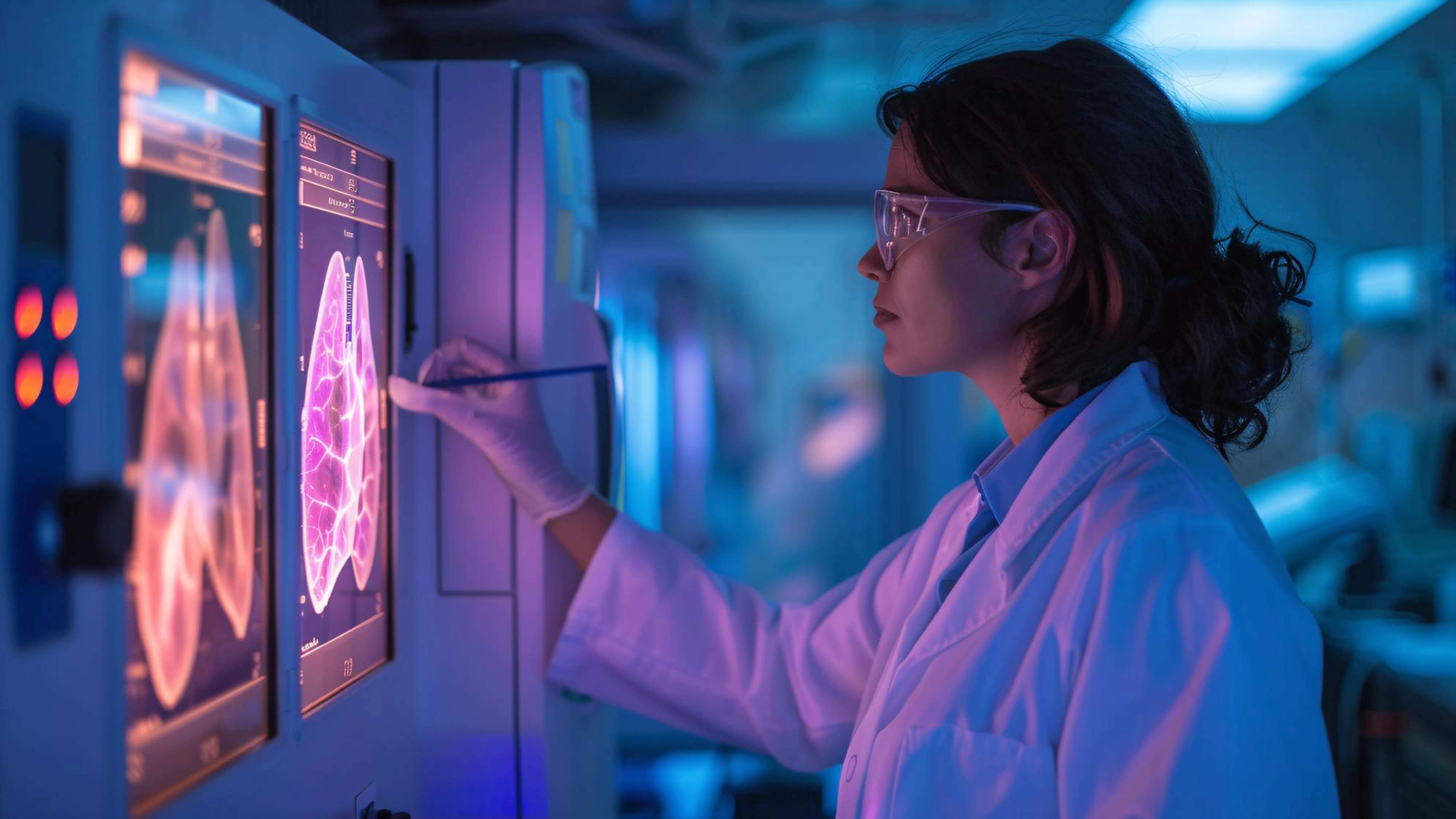
- Medical Imaging Analysis AI enhances radiology by detecting abnormalities in scans such as CT, MRI, and mammograms with high accuracy. It helps identify tumors, prioritize urgent cases, and streamline radiology workflows, leading to quicker diagnoses and reduced errors.
- Digital Pathology AI systems analyze digitized tissue slides, identifying cancer subtypes and tumor features with greater consistency and speed. This improves diagnostic accuracy and supports more personalized treatment strategies.
- Genomics and Biomarker Discovery AI accelerates the analysis of genomic data from next-generation sequencing, identifying driver mutations and biomarkers. This enables precision oncology by linking patients to targeted therapies based on their molecular profiles.
- Radiomics and Radio Genomics By extracting complex features from imaging data and linking them with genomic insights, AI enables non-invasive tumor profiling and prediction of treatment responses. This deepens understanding of tumor behavior without repeat biopsies.
- Liquid Biopsies AI improves the sensitivity of blood-based cancer detection by accurately interpreting circulating tumor DNA and other molecular markers. This allows for earlier diagnosis, monitoring of disease progression, and detection of treatment resistance.
- Radiation Therapy Optimization AI assists in planning radiation therapy by automating tumor contouring, personalizing dose distribution, and improving targeting accuracy. This enhances treatment precision while reducing planning time and clinician workload.
- Integrated Decision Support AI-powered platforms unify patient data across labs, imaging, genomics, and EMRs into single dashboards. Clinicians gain real-time alerts, evidence-based recommendations, and improved collaboration for faster, more informed decision-making.
From Data to Diagnosis: ThinkBio.Ai®’s Precision Platforms in Cancer Care
At ThinkBio.Ai®, we’ve developed advanced platforms that bring real-world AI capabilities to cancer diagnosis and precision oncology.
TheraBluePrint is our AI-driven platform designed to integrate multimodal patient data like clinical, molecular, imaging, and real-world evidence, to generate individualized diagnostic and therapeutic insights.
In the context of cancer, it empowers oncologists and researchers to stratify patients more accurately, predict treatment responses, and align care pathways with the latest evidence and biomarker-driven strategies.
Pixelomics, on the other hand, bridges the gap between imaging and omics data. This platform uses AI to analyze digital pathology images, radiology scans, and omics data, extracting high-resolution insights at the pixel and molecular level.
It enables nuanced tumor profiling, reveals spatial heterogeneity, and supports virtual biopsy capabilities for continuous monitoring and assessment. Together, these platforms reflect our commitment to building a smarter, more connected diagnostic ecosystem where AI doesn’t just process data, but translates it into actionable, patient-specific insights.
To conclude, AI is fundamentally reshaping the way cancer is diagnosed by bringing speed, precision, and personalization to the diagnostic process. From detecting subtle anomalies in scans to interpreting complex genomic patterns, AI enhances the clinician’s toolkit while scaling expertise across the healthcare system.
Far from replacing specialists, AI serves as a powerful ally by amplifying human judgment, reducing diagnostic errors, and enabling earlier, more targeted interventions. Its ability to unify complex data sources and personalize recommendations makes it a cornerstone of next-generation oncology care.
As AI continues to evolve, its integration into cancer diagnosis is not just a technological upgrade; it represents a paradigm shift toward more proactive, precise, and equitable healthcare. With responsible implementation, AI holds the promise to detect cancers earlier, tailor treatments better, and ultimately save more lives.

Build the future of
biology with us
Contact Us
Stay Ahead with
ThinkBio.Ai®
Subscribe to our newsletter to receive the latest updates on products, sustainability efforts and services.