

About Our Platform
AI-Driven Research Workflows, Knowledge, and Data in One Unified Platform
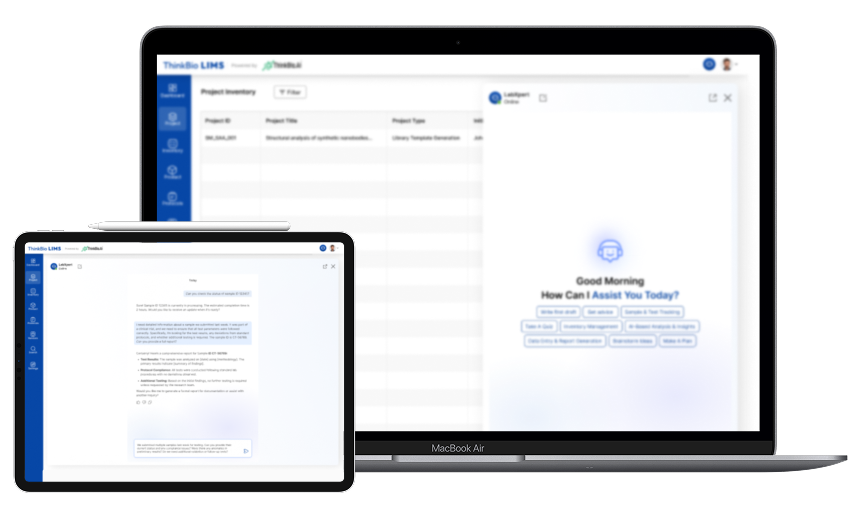
Biomedical research is evolving rapidly, but traditional LIMS can’t keep pace with the data complexity and speed required for modern discovery. ThinkBio R-COP is an intelligent, AI-driven platform that supports researchers, lab managers, and scientists in biotech, biopharma, and academia. It streamlines experimental workflows, automates routine tasks, and integrates siloed data to accelerate hypothesis generation, inventory planning, and analysis. Designed for adaptability, ThinkBio R-COP transforms disconnected systems into a cohesive, knowledge-rich research environment.Why Use ThinkBio R-COP?
Accelerate Discovery with Modular AI Support for Researchers
ThinkBio R-COP goes beyond conventional LIMS systems by offering real-time, intelligent guidance at every step. It helps researchers design more effective experiments, reduce trial-and-error cycles, optimize reagent and technology use, and surface high-confidence hypotheses faster. Powered by large language models (LLMs) and domain-specific data engines, ThinkBio R-COP ensures every scientific decision is informed and cost-efficient.
HOW IT WORKS
Purpose-Built AI Copilots for Each Phase of Research

Understand Your Research Context
ThinkBio R-COP's Knowledge Co-Pilot continuously ingests scientific literature, assay methods, and domain-specific data to build a knowledge layer that guides every decision—from experiment design to result interpretation.
Design Smarter Experiments
With a simple prompt, the Experiment Co-Pilot generates step-by-step protocols, recommends alternatives, and integrates with your LIMS to streamline planning and execution.
Optimize Tools & Resources
The Technology Co-Pilot ensures readiness by checking inventory, comparing assay options, and triggering procurement if needed—minimizing delays and unnecessary costs.
Analyze & Interpret in Real Time
Data Co-Pilot collects and analyzes experimental data, visualizes insights, compares with benchmark datasets, and works with the Knowledge Co-Pilot to suggest next steps or improvements.

Contact Us
Would you like us to get in touch with you? Fill up the form & we will reach out to you
