

Evidence Retrieval & Curation
Aggregates and organizes curated evidence from scientific literature, immunology databases, and biomedical sources.
About Our Platform
Why Use ThinkBio-EMIL™
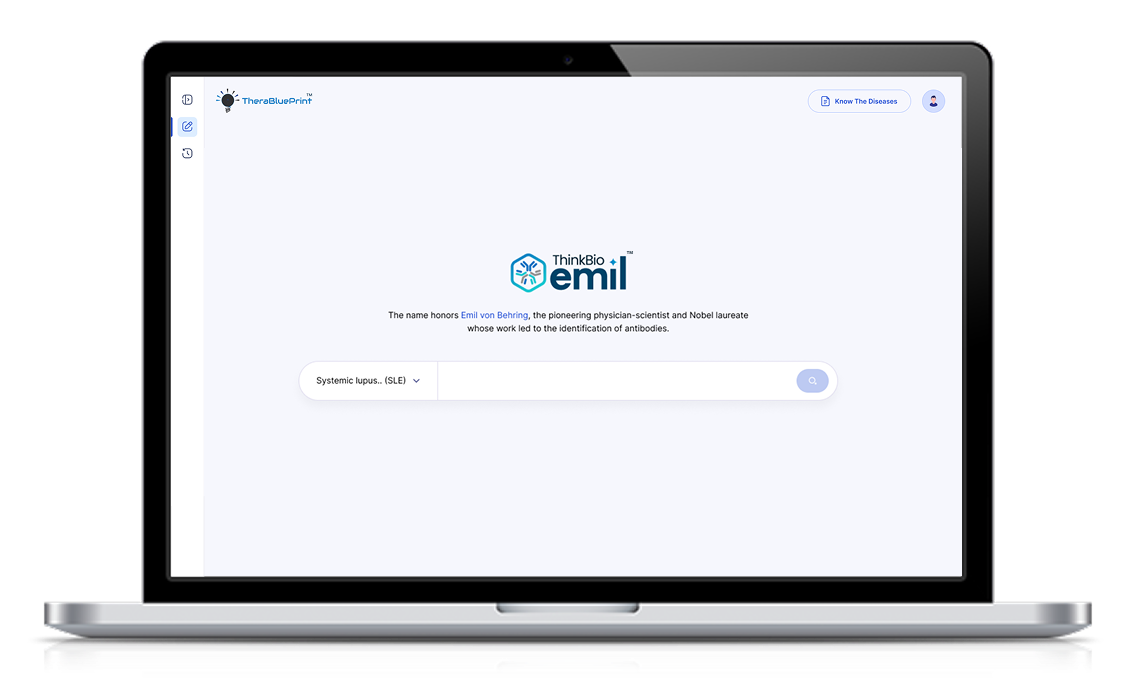
Immune-mediated inflammatory diseases are driven by complex biological pathways that are often difficult to interpret using traditional research tools. ThinkBio-EMIL™ integrates clinical evidence, multimodal omics, and curated immunology knowledge within a unified AI-powered platform to uncover disease mechanisms, identify biomarkers, and prioritize therapeutic opportunities. By delivering explainable, evidence-based insights, the platform helps researchers reduce data complexity, accelerate discovery, and make more confident R&D decisions across the translational research continuum.

How it works
ThinkBio-EMIL™ uses a multi-agent architecture where specialized AI agents collaborate to retrieve, interpret, and synthesize immunology knowledge, transforming fragmented data into actionable biological insight.
Aggregates and organizes curated evidence from scientific literature, immunology databases, and biomedical sources.

Maps findings to immune pathways, disease mechanisms, biomarkers, and therapeutic targets.

Combines immune omics data and proprietary analyses with curated scientific knowledge.

Synthesizes insights to identify biomarkers, uncover mechanisms, and highlight therapeutic opportunities.

Integrates clinical evidence, scientific literature, molecular datasets, and immune omics into a connected intelligence layer that provides comprehensive biological context for translational decision-making.
A virtual immunology expert designed to support biomarker discovery, mechanistic understanding, and therapeutic innovation across immune-mediated inflammatory diseases.
Specialized AI agents collaborate to retrieve, interpret, and synthesize evidence, enabling deeper biological insight beyond traditional search.
Integrates curated literature, immune omics data, and proprietary analyses to connect biological signals across datasets and studies.
Identifies candidate biomarkers for patient stratification, response prediction, and disease monitoring.
Links immune pathways, disease biology, and clinical observations to uncover underlying disease mechanisms.
Highlights potential targets and pathways to support next-generation therapeutic development.
Connects insights across IMIDs, oncology, and immunology to reveal novel biological relationships.
Supports researchers in generating testable, translationally relevant scientific hypotheses.
Accessible through secure cloud infrastructure with flexible deployment options, including SaaS and client-hosted environments.
Frequently Asked Questions
ThinkBio EMIL™ combines AI-driven scientific reasoning with curated immunology knowledge, immune omics data, and biomedical literature to identify candidate biomarkers for patient stratification, disease progression, and treatment response. By integrating multimodal evidence, the platform helps research teams accelerate biomarker discovery and translational research in IMIDs.
ThinkBio EMIL™ uses a multi-agent AI architecture in which specialized AI agents retrieve, interpret, and synthesize scientific evidence from literature, immune pathways, omics datasets, and biological analyses. This enables researchers to uncover disease mechanisms, generate testable hypotheses, and make evidence-based decisions with greater confidence.
ThinkBio EMIL™ integrates curated scientific literature, immune omics data, immunology databases, proprietary biological analyses, and translational research evidence into a unified intelligence platform. This multimodal approach provides a comprehensive view of immune biology to support biomarker discovery, therapeutic target identification, and precision medicine initiatives.
ThinkBio EMIL™ analyzes immune pathways, disease biology, biomarkers, and cross-disease relationships to identify promising therapeutic targets and biological mechanisms. By connecting molecular evidence with translational insights, the platform helps researchers prioritize high-value targets for next-generation therapeutic development.
ThinkBio EMIL™ is designed for biopharmaceutical companies, translational research teams, precision medicine programs, clinical strategy groups, and academic researchers working in autoimmune and inflammatory diseases. It supports applications including biomarker discovery, patient stratification, therapeutic development, and translational immunology research.
ThinkBio EMIL™ transforms fragmented scientific, clinical, and molecular evidence into actionable insights using AI-powered scientific reasoning. By prioritizing biomarkers, patient populations, immune pathways, and therapeutic opportunities, the platform enables faster, evidence-based decision-making and helps reduce the time required to evaluate complex immunology research questions.
Stay Ahead with
ThinkBio.Ai®
Subscribe to our newsletter to receive the latest updates on products, sustainability efforts and services.
